Which course fits your situation — and how it can help your case
Many people come to Clearway Institute because a court, attorney, mediator, or custody evaluator recommended or required a course like this — often as part of a custody case, divorce, or parenting plan. Here’s a plain explanation of what each course covers, why it’s typically requested, and how finishing one can support your position.
This page explains general patterns we see and hear from customers — it isn’t legal advice and isn’t a guarantee of any outcome. Requirements, and how much weight a certificate carries, vary by state, county, and judge. For guidance on your specific case, talk with your attorney or the court.
Why these courses matter in custody cases
Documented proof of effort
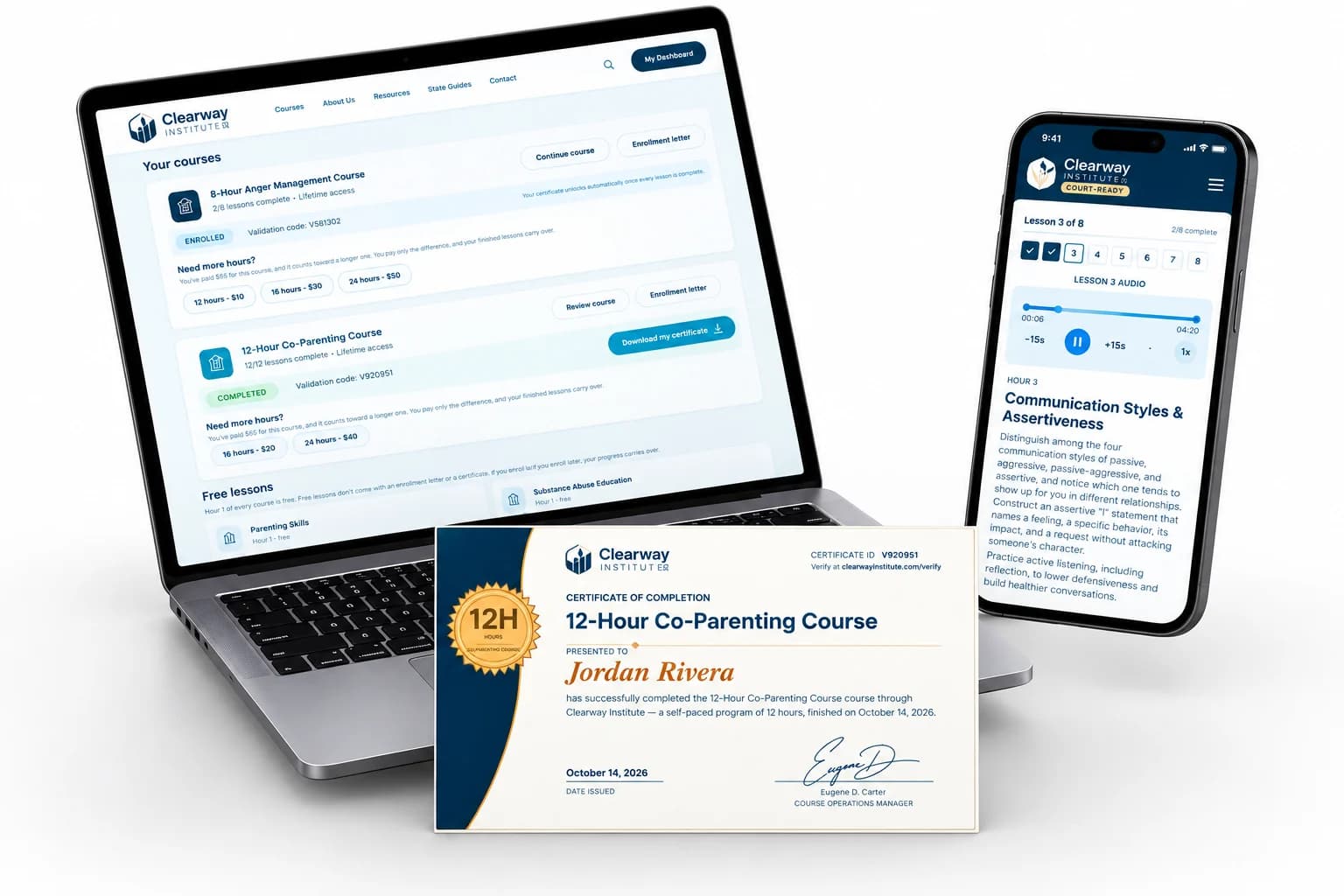
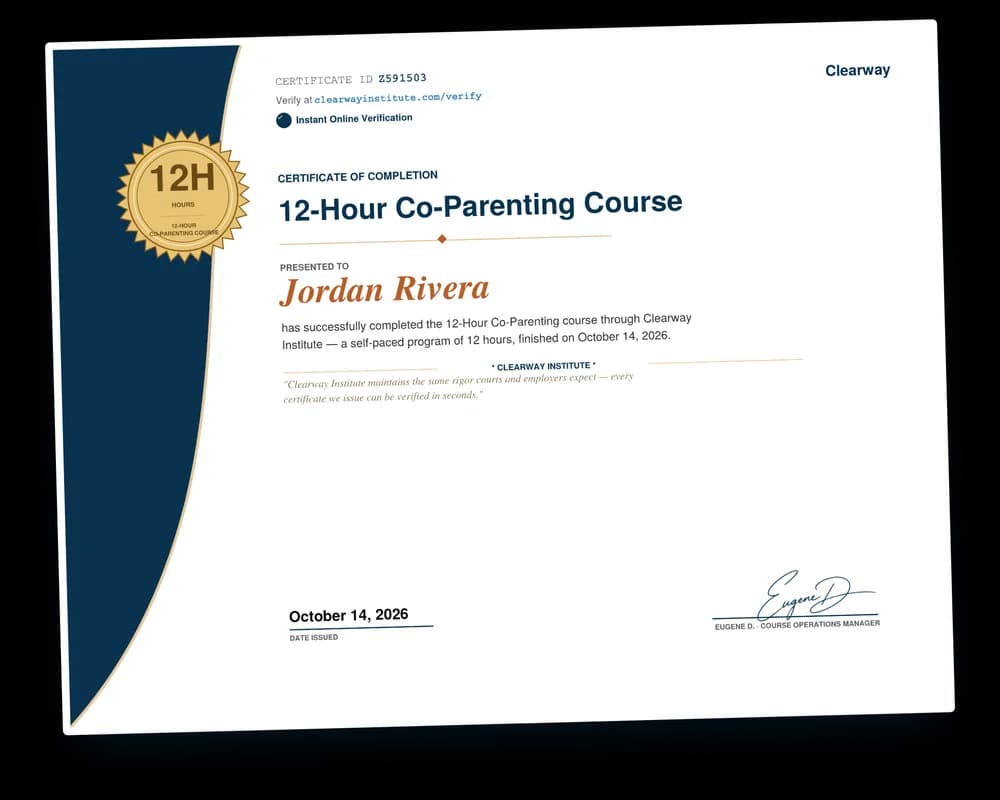
Every certificate carries a unique verification number that the court, your attorney, or the other parent's counsel can check anytime on our verification page — so it's not just your word that you completed it.
Addresses the actual concern
Courts and evaluators generally respond better to a course that targets the specific issue raised in your case — anger, parenting ability, co-parenting conflict, or substance use — rather than a generic class that doesn't match it.
Shows you're being proactive
Taking a course before it's ordered, finishing one early, or adding courses beyond what you were required to take can show the court and family court services that you're working on the situation on your own, not just complying. It can reflect well on you, though every judge and evaluator weighs it differently and it isn't a guarantee of any outcome.
Gives you tools you can point to
Beyond the certificate, you walk away with specific skills — de-escalation techniques, a parenting framework, communication scripts — that you can describe in a hearing, mediation, or evaluation.
The four course tracks
Every course runs 1–24 hours depending on the length you need — pick the same length your court, employer, or program specified. The content is identical either way, just more or less of it.
Anger Management
A practical, skills-based course covering triggers, calming techniques, thought patterns, and communication — for anyone who wants a steadier response to frustration and conflict.
One of the most commonly ordered courses in custody and divorce cases — typically after an incident of yelling or aggression, a police call, a protective order, or when the other parent raises concerns about emotional control during exchanges or communication.
Completing it gives you a documented, concrete answer to “what have you done about this?” The skills covered — recognizing triggers, de-escalation, calmer communication — are the kind of progress custody evaluators and judges often look for.
Parenting Skills
Child development, positive discipline, communication, and routines — a well-rounded course for any parent who wants a calmer, more connected household.
Common when a case involves a parenting-ability dispute, a child welfare case, or a judge who wants both parents working from the same, age-appropriate playbook on discipline, routines, and child development.
It builds a record that you understand child development and positive discipline — directly relevant to the “best interest of the child” standard that nearly every state uses to decide custody and parenting time.
Co-Parenting
Built for separated and divorced parents — communication, custody transitions, keeping kids out of the middle, and building a working partnership with your co-parent.
Built specifically for separated or divorced parents, and ordered when the conflict is between the parents rather than with the child: hostile exchanges, badmouthing, trouble agreeing on a parenting plan, or putting kids in the middle.
Because it targets co-parenting conflict directly, it's often the single most relevant course you can point to in a custody dispute — reduced conflict between parents is one of the factors judges weigh most heavily.
Substance Abuse Education
An educational course on substance use patterns, triggers, coping skills, and relapse prevention — not a treatment program, but a solid starting point.
Ordered when substance use has come up in a case — through an allegation, a failed test, a DUI, or a judge wanting reassurance.
A completed certificate documents that you understand triggers and relapse-prevention planning, which is often what a court is asking to see.
See exactly what you get
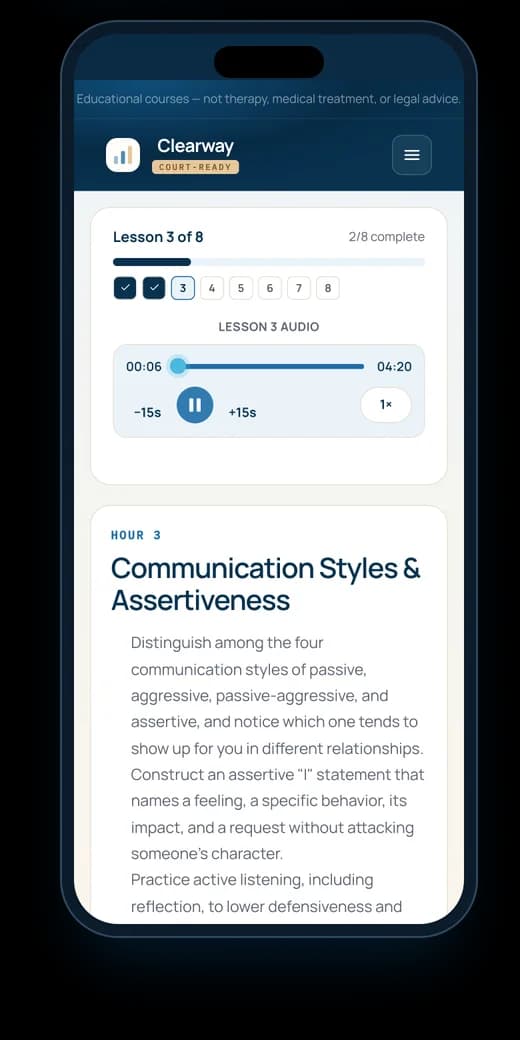
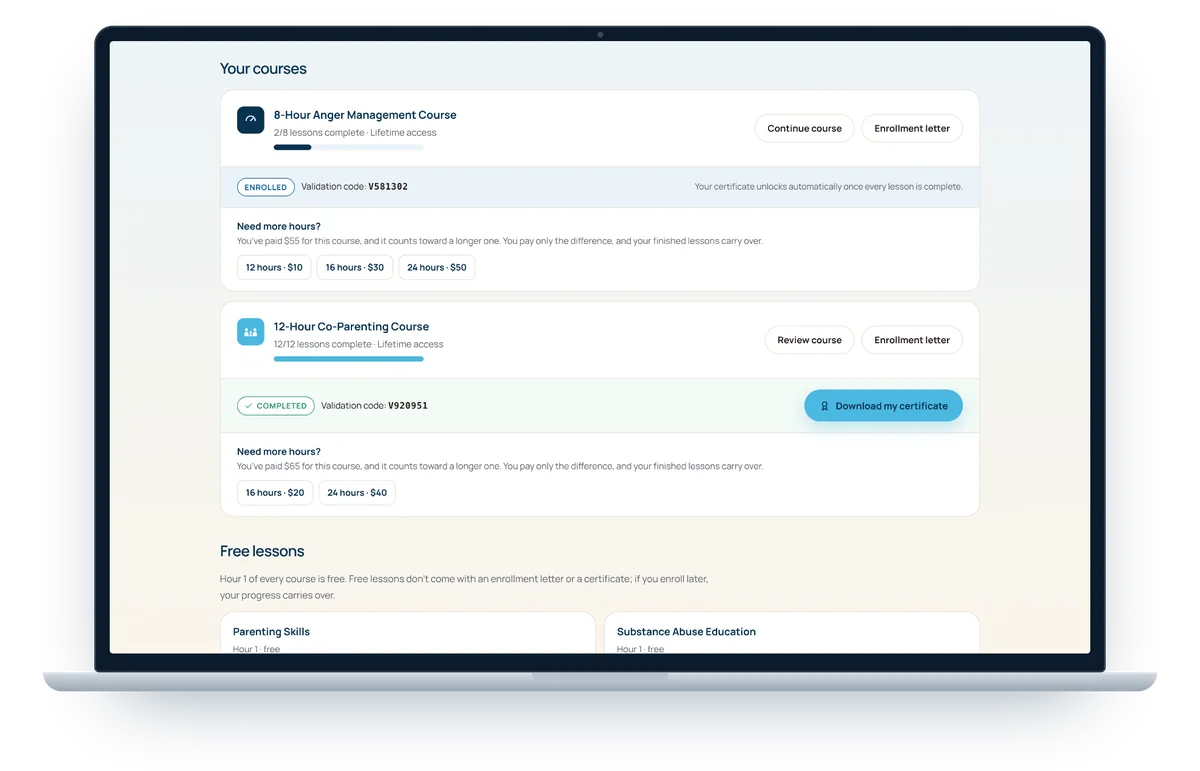
Your dashboard, a lesson with full audio, and your certificate, shown with a sample student.
Not sure which one you need?
If your court order, attorney, or program specifies a course by name, that’s the one to take. If you’re not sure, see full pricing and lengths, or reach out and we’ll help you figure out which track matches your situation.